Pick up a banknote and really look at it. Someone decided what's printed on it, what it's worth, and why another person would accept it in exchange for something real. That act of acceptance — the shared belief that a piece of paper holds value — is one of the stranger and more fascinating inventions in human history.
Money is so embedded in daily life that most people never stop to question where it came from or why it works the way it does. The history of currency is genuinely interesting — full of surprising turns, failed experiments, and ideas that seem obvious in hindsight but required centuries to develop.
Understanding that history also makes the present make more sense. Why exchange rates fluctuate. Why central banks matter. Why the USD is still the world's reserve currency. Why Bitcoin keeps coming up in conversations about the future of finance.
The Early Barter System
Before money, people traded directly. The core problem economists call the "double coincidence of wants" — you need to find someone who has exactly what you want and wants exactly what you have, at the same moment, in compatible quantities. A blacksmith can't pay for a haircut in half a horseshoe.
To solve this, early societies began using commodity money — goods with recognized, reliable value. Cowrie shells served as currency in parts of Africa and China as far back as 1200 BCE. Salt was used to pay Roman soldiers — the word "salary" derives from the Latin salarium, meaning salt payment. These commodity currencies solved the coincidence-of-wants problem but introduced new ones: they were heavy, perishable, hard to standardize.
The Birth of Coins and Metal Currency
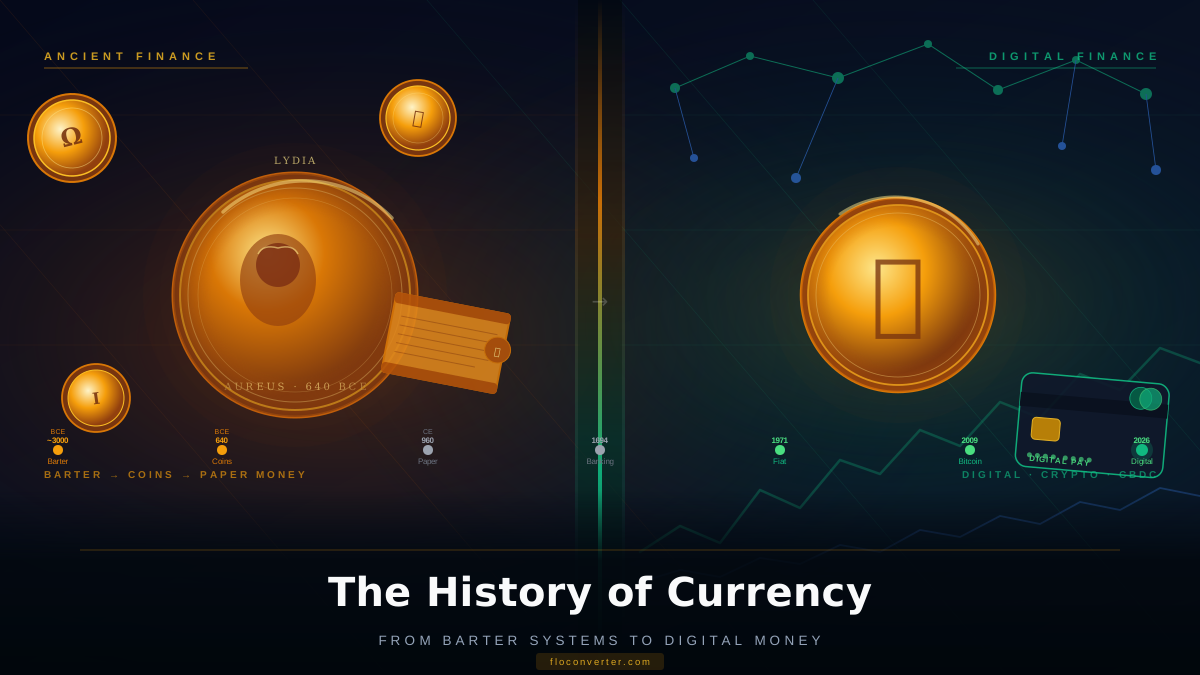
The first standardized coins are generally traced to Lydia — a kingdom in what is now western Turkey — around 640 BCE. Under King Alyattes, coins were minted from electrum and stamped with official symbols to guarantee their weight and purity. For the first time, you didn't need to weigh or test metal at every transaction.
The idea spread rapidly. Greece, Rome, Persia, China, and India all developed their own coinage systems. Gold and silver emerged as the dominant metals: durable, divisible, naturally scarce, and universally recognized. Metal coinage solved most of barter's problems, but carrying large sums of metal was heavy and dangerous.
The Rise of Paper Money
Paper money is, historically, a Chinese invention. During the Tang Dynasty (618–907 CE), Chinese merchants began using feiqian — "flying money" — certificates that allowed merchants to deposit coins with a trusted agent in one city and retrieve equivalent value in another.
The Song Dynasty took it further. Around 960 CE, private banks in Sichuan province began issuing jiaozi — paper receipts redeemable for coins. These were the world's first true banknotes. Sweden's Stockholm Banco issued the first European banknotes in 1661, and the Bank of England — founded in 1694 — became the model for central banking as we know it.
The shift from precious metal to paper represented a significant conceptual leap: money backed not by intrinsic material value but by institutional trust.
The Gold Standard and Modern Banking
The 19th century brought the gold standard — currency directly convertible to a fixed amount of gold. After World War II, the Bretton Woods Agreement (1944) created a new international monetary order: all currencies would be pegged to the US Dollar, which remained convertible to gold at $35 per ounce. The USD became the world's reserve currency.
The final break came in 1971. President Nixon ended the dollar's convertibility to gold — the "Nixon Shock." From that moment, all major currencies became fiat money — backed not by gold but by government decree and market confidence.
The Modern Forex Market
Today, the forex market is the world's largest financial market, with over $7 trillion traded daily. Major pairs like USD/EUR, GBP/USD, and USD/INR are quoted and traded continuously across Tokyo, London, New York, and Singapore.
The Digital Payment Revolution
Cryptocurrency and the Future of Money
In January 2009, the first Bitcoin transaction was recorded. Bitcoin proposed something genuinely new: a currency with no central issuing authority, secured by cryptography and maintained by a decentralized network. The underlying blockchain technology had no direct historical precedent.
Governments responded by developing their own digital currencies. China's digital yuan (e-CNY) is the most advanced central bank digital currency (CBDC) currently in deployment. The European Central Bank is exploring a digital Euro.
The history of currency is, at its core, the history of trust at scale. floconverter gives you the live mid-market rate — updated in real time — for the latest chapter of that story. Track live rates for 170+ currencies at floconverter Live Rates.